Champagne Category
Vintage Champagne 2015: Why Every Serious Collector Is Still Buying It | Noir Cellars

Jun
Vintage Champagne 2015: Why Every Serious Collector Is Still Buying It
There are good Champagne vintages, great ones, and then there are the vintages that get talked about across dinner tables for twenty years after the harvest.
The 2015 is one of those vintages.
Not because it was the most challenging year — those often produce the most intellectually interesting wines. Not because it was the rarest — scarcity alone does not make a great vintage. But because the summer of 2015 in Champagne delivered exactly the conditions that produce Champagne at its most generous, complete, and age-worthy: sunshine without brutality, ripeness without over-extraction, a harvest that arrived at the precise moment when every variety had reached its fullest potential.
The houses that declared a vintage in 2015 — and most of the great ones did — produced Champagnes of extraordinary quality. Nearly a decade on from that harvest, the finest vintage Champagne 2015 expressions are entering what critics are calling their first true drinking window. And for buyers who missed the initial release, this window is also one of the most compelling buying opportunities currently available in the prestige Champagne market.
This is the complete guide to why vintage Champagne 2015 deserves your attention, which bottles to prioritise, what they taste like now versus what they will become, and how to buy with confidence.
What Made 2015 Such an Exceptional Champagne Vintage?
The 2015 growing season in Champagne was warm and sunny throughout, delivering excellent ripeness across all three major varieties — Chardonnay, Pinot Noir, and Pinot Meunier. Harvests began unusually early, on 7th September in some areas, with grapes arriving in pristine sanitary condition and extraordinarily high natural sugar levels. Global Relocate
To understand why this matters, you need to understand the challenge Champagne faces every single year. The region sits at the northern extreme of viable viticulture — it is cold, unpredictable, and prone to the kind of spring frosts and summer rain that can compromise a harvest in days. The tension that makes great Champagne possible — between the natural acidity of cool-climate fruit and the ripeness that sun and warmth provide — requires near-perfect seasonal conditions to achieve. Too cold and the fruit is sharp and thin. Too warm and it is flabby, short-lived, lacking the structural backbone for long ageing.
The 2015 growing season navigated that balance exceptionally well. The warmth of the summer concentrated the natural sugars in the grapes — giving the wines their characteristic generosity and full-bodied richness — while the chalk subsoils of the Champagne region retained enough moisture to keep natural acidity intact. The result was fruit of remarkable quality that produced, in the hands of the great houses, Champagnes of both immediate appeal and serious long-term potential.
Wine critic Antonio Galloni of Vinous described the 2015 vintage as one of the most exciting in recent memory, with wines showing extraordinary depth and a generosity of fruit rarely seen in Champagne. Global Relocate
Vintage Champagne 2015 Now: What to Expect in the Glass Today
This is the question every serious buyer asks before committing to a vintage Champagne purchase: how does it taste right now, and is this the right moment to buy?
Vintage Champagne 2015 is, in 2025/2026, in what wine professionals call the early drinking window — the period after release when the wine has settled from its initial disgorging, the primary fruit is at its most vivid and expressive, and the first hints of development and secondary complexity are beginning to emerge.
The character of vintage Champagne 2015 across the great houses shows a remarkably consistent fingerprint, regardless of blend composition:
Primary flavours (what you taste now): White peach, nectarine, golden apple, ripe citrus peel, toasted brioche, hazelnut, and — in Pinot Noir-dominant blends — a subtle red fruit undercurrent of wild cherry and raspberry. The mousse is typically fine and persistent, reflecting the high natural pressure achieved by the healthy fruit.
Secondary development (what is beginning to emerge): Honey, beeswax, preserved lemon, almond pastry, and a building minerality as the wine integrates and the primary fruit slowly gives way to more complex, tertiary notes.
Structure: The hallmark of great vintage Champagne 2015 is a balance between richness and freshness that many vintages fail to achieve. The wines feel generous and open-handed — they are not austere or demanding, the way a 2013 can be — but they are not soft or without tension. They have the architecture to age for another 10–15 years in the right cellaring conditions.
The consensus among serious Champagne professionals is clear: vintage Champagne 2015 is drinking beautifully right now, will continue to improve for at least a decade, and is at one of the most rewarding points in its evolution. For buyers who want a vintage Champagne that delivers both immediate pleasure and long-term investment, this is an ideal combination.
The Best Vintage Champagne 2015 Bottles to Buy: House by House
Dom Pérignon 2015
The benchmark. Dom Pérignon’s 2015 is widely considered one of the most successful releases of the current decade — a vintage Champagne that captures everything the 2015 growing season gave and translates it into the house’s characteristic blend of Pinot Noir and Chardonnay with extraordinary elegance.
Wine Spectator awarded the 2015 Dom Pérignon 94 points. Antonio Galloni at Vinous gave it 95. The tasting notes across critics are unusually consistent: white peach, toasted brioche, almond, chalk, a long golden finish. What they all agree on is the balance — a vintage Champagne that drinks like a wine twice its age without sacrificing an ounce of its immediate appeal.
For the 2015 vintage, Dom Pérignon also represents one of the most compelling price points in the prestige tier. Secondary market demand has built steadily since the initial release but has not yet reached the stratospheric levels of the 2008 — meaning that buyers purchasing vintage Champagne 2015 Dom Pérignon now are doing so while there is still meaningful upside potential in the price.
Price at Noir Cellars: from $295 | Buy Dom Pérignon 2015 →
Read our complete Dom Pérignon guide → for full vintage analysis and Plénitude system explained.
Louis Roederer Cristal 2015
Cristal 2015 earned 96 points from Wine Spectator — an extraordinary score that places it among the finest prestige Champagnes of the decade. The vintage produced a Cristal of exceptional depth and purity, with aromas of white flowers, toasted brioche, and ripe golden fruits giving way to a palate of remarkable precision and length. Alcohol Help
Cristal has a particular advantage in the 2015 vintage: Louis Roederer farms its own Grand Cru vineyards biodynamically, which meant the 2015 harvest from their estate parcels was managed with a level of precision unavailable to houses sourcing grapes from the open market. The result is a vintage Champagne 2015 with an estate character — a sense of place and specificity — that distinguishes it from other great houses at the same price point.
Price at Noir Cellars: from $265 | Buy Cristal 2015 →
Taittinger Comtes de Champagne Blanc de Blancs 2015
The 2015 growing season was particularly generous to Chardonnay — warm days developing concentration and complexity while chalk subsoils maintained the mineral tension and freshness that Blanc de Blancs requires. Taittinger’s Comtes de Champagne, sourced exclusively from Grand Cru Chardonnay vineyards in the Côte des Blancs, translated this perfectly.
Vintage Champagne 2015 Comtes is arguably the finest value proposition in the prestige Blanc de Blancs category right now. At a price meaningfully below Salon and Krug Clos du Mesnil, it delivers a vintage Champagne experience of comparable seriousness — mineral, precise, complex, and built for another 10–15 years of evolution. For buyers building a serious cellar on a considered budget, this is the vintage Champagne 2015 bottle to prioritise.
Price at Noir Cellars: from $195 | Buy Comtes de Champagne 2015 →
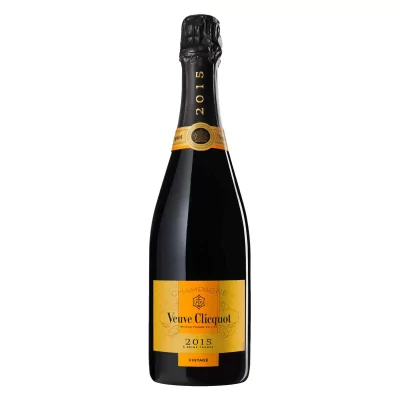
Krug Grande Cuvée 164ème Édition (Base Vintage 2008 with 2015 Components)
A slight variation on the direct vintage question — but important for buyers interested in how 2015 fruit appears in Krug’s range. The 164ème and 165ème Éditions of Krug Grande Cuvée both incorporated significant proportions of 2015 fruit alongside reserve wines from older harvests, meaning that the extraordinary quality of the 2015 growing season is woven into these multi-vintage blends in ways that serious buyers should know about.
For buyers who want a direct vintage Champagne 2015, however, Krug’s Vintage 2008 is the current standard-release vintage — the 2015 Krug Vintage will not arrive on the market until at least the early 2030s, given the house’s minimum ten-year lees ageing requirement.
Explore Krug at Noir Cellars → | Read our complete Krug guide →
Bollinger La Grande Année 2015
Bollinger’s prestige cuvée is one of the most food-friendly and structured of all the great vintage Champagnes — and the 2015 La Grande Année is no exception. Pinot Noir-dominant, vinified partly in old oak barrels, and built with the kind of density and grip that rewards a decade of cellaring, La Grande Année 2015 is the vintage Champagne for buyers who want structure and seriousness alongside the vintage’s characteristic generosity.
An outstanding pairing partner for lobster, turbot, roasted chicken with cream, and aged hard cheeses — this is vintage Champagne 2015 for the dinner table rather than the aperitif glass.
Price at Noir Cellars: from $185 | Buy Bollinger La Grande Année 2015 →
Armand de Brignac Brut Gold — The Lifestyle Interpretation of 2015 Fruit
While Armand de Brignac does not produce a directly labelled 2015 vintage expression, the current Brut Gold incorporates significant proportions of 2015 and adjacent harvest fruit in its multi-vintage blend. For buyers who want the 2015 fruit character within the Ace of Spades presentation format, the current Brut Gold delivers that dimension alongside older reserve wine complexity.
Buy Armand de Brignac Brut Gold → | Read our Ace of Spades price guide →
Vintage Champagne 2015 vs Other Recent Vintages: How Does It Compare?
Understanding vintage Champagne 2015 in the context of recent releases helps buyers make smarter purchasing decisions — particularly those building a cellar or managing a wine investment portfolio.
2015 vs 2013: The 2013 vintage Champagne is more mineral, more restrained, more linear — built for longer ageing and demanding more patience. The 2015 is more generous, more approachable, more immediately pleasurable. Both are excellent; the choice depends on whether you are buying to drink in the next five years (2015) or cellar for 10–15 (2013 or 2015 in equal measure).
2015 vs 2012: The 2012 vintage Champagne shares 2015’s warmth-driven concentration but produced wines of slightly more structured, Burgundian tension. Critical scores for 2012 prestige cuvées are slightly higher across the board, but 2015 is more accessible now and has more immediate charm. Both belong in a serious cellar.
2015 vs 2008: The 2008 vintage Champagne is in a category of its own — widely considered the finest modern vintage, producing wines of electrifying precision, structural complexity, and ageing potential that the 2015 does not challenge at the upper end. For investment grade vintage Champagne, 2008 remains the primary market target. For accessible prestige drinking with strong development potential, 2015 is the more sensible current-market choice. Read our Dom Pérignon guide → for the full 2008 vs 2015 comparison at the Dom Pérignon level.
Vintage Champagne 2015 as an Investment
According to Winecap’s 2025 fine wine analysis, over 85% of flagship Champagne vintage expressions have halted their price declines following the 2022–2023 market correction, with prestige cuvée vintage Champagnes showing the first signs of renewed appreciation. CIA
Vintage Champagne 2015 sits at a particularly interesting investment inflection point. The initial release prices have fully settled. The critical consensus is established and consistently strong — there are no downward revisions coming. The wine is now in its early drinking window, which means it is at a stage of development that buyers can assess directly rather than projecting from speculation. And the production of the finest expressions — Dom Pérignon, Cristal, Comtes de Champagne — is fixed: no more bottles are being made. Every unit consumed narrows the supply against what remains a deep and growing global collector base.
For buyers adding vintage Champagne 2015 to a wine investment portfolio, the key principles are:
- Buy in original sealed case where possible — six-bottle or twelve-bottle case format commands a premium on secondary market and documents provenance
- Prioritise the established prestige houses — Dom Pérignon, Cristal, and Taittinger Comtes have the deepest secondary market liquidity
- Consider Magnum format — vintage Champagne 2015 in Magnum ages more slowly and commands a proportionally higher premium on the secondary market than the equivalent standard bottles
- Store professionally — a 10–14°C environment, 60–70% humidity, no vibration, no direct light. Our concierge team can advise on bonded storage options
For the broader investment context, read our guide to buying fine wine and Champagne for investment →.
Cellaring Vintage Champagne 2015: How Long and How to Do It
The two questions most buyers ask about cellaring vintage Champagne 2015: how long can it age, and what do they need to do to make that happen safely?
On timing: the finest vintage Champagne 2015 expressions — Dom Pérignon, Cristal, Comtes de Champagne — are built for drinking windows of 20–25 years from disgorging. In practical terms, that means bottles disgorged in 2023 or 2024 will be at their peak somewhere between 2030 and 2040, and will still be drinking well into the late 2040s in proper storage. The generous fruit of the 2015 vintage means the wine is drinking beautifully right now — but the structural backbone and chalk-driven acidity ensure that patience will be significantly rewarded.
On storage: vintage Champagne 2015 should be stored horizontally, at a consistent 10–14°C, in darkness, without vibration. The consistent temperature is the single most critical factor — fluctuations cause the wine to expand and contract against the cork, accelerating ageing unpredictably and damaging the complex bubble formation that makes aged Champagne so special.
For buyers without dedicated cellar space, our Champagne collection → includes bottles that have been stored in our own temperature-controlled facilities from receipt — providing documented storage history that adds both drinking confidence and secondary market provenance.
Frequently Asked Questions
Is the 2015 a good vintage for Champagne? Yes — unequivocally. The 2015 growing season delivered warm, sunny conditions that produced grapes of exceptional ripeness and quality across all three major Champagne varieties. The resulting wines are generous, full-bodied, and structured for long ageing. Critical consensus across all major Champagne critics rates 2015 as one of the finest vintages of the past fifteen years, behind only 2008 in recent memory.
Which vintage Champagne 2015 is the best to buy? Dom Pérignon 2015 is the benchmark — the highest profile, most critically acclaimed, and most liquid investment-grade expression. For the best value at the prestige tier, Taittinger Comtes de Champagne 2015 consistently overdelivers at its price point. For estate-grown purity and critical acclaim, Louis Roederer Cristal 2015 at 96 points from Wine Spectator is exceptional. Browse all available vintage Champagne 2015 expressions at Noir Cellars →.
Can you still buy vintage Champagne 2015? Yes — vintage Champagne 2015 remains available from specialist retailers including Noir Cellars, both as original-release primary market stock and through secondary market channels. Availability is becoming more selective as stocks are consumed, so current buying represents better selection than will be available in two to three years.
How does vintage Champagne 2015 compare to 2008? The 2008 is the finer vintage by critical consensus — more structured, more mineral, and built for longer ageing. Vintage Champagne 2015 is more approachable now, more generous in style, and available at more accessible price points. For investment grade buying, 2008 leads. For accessible prestige drinking with strong development potential, 2015 is the smart current-market choice. See our Dom Pérignon guide → for the full comparison.
How long does vintage Champagne 2015 last in the cellar? The finest vintage Champagne 2015 expressions — Dom Pérignon, Cristal, Comtes de Champagne — are built for 20–25 year drinking windows from disgorging. In proper storage conditions (10–14°C, constant temperature, no vibration), bottles disgorged in 2023–2024 will be drinking well into the 2040s and potentially beyond.
Is vintage Champagne 2015 a good gift? Exceptional. A vintage Champagne gift from 2015 is particularly meaningful for anyone born in 2015 — a bottle to open on an 18th or 21st birthday — or for anyone celebrating a milestone from that year. For gifting guidance and luxury packaging options, visit our Champagne gift delivery guide → or browse our full gift collection →.
Every major vintage Champagne 2015 expression is available at Noir Cellars — Dom Pérignon, Cristal, Comtes de Champagne, Bollinger La Grande Année, and more — with temperature-controlled storage, full provenance documentation, and insured worldwide delivery. Visit noircellars.com/champagne or contact our concierge team at concierge@noircellars.com.