Wine Category
Screaming Eagle Wine: The Jaw-Dropping Story Behind Napa’s Most Impossible Bottle
Jul
Screaming Eagle Wine: The Jaw-Dropping Story Behind Napa’s Most Impossible Bottle
There is a Cabernet Sauvignon produced every year in Oakville, Napa Valley, in quantities so small that the entire global wine trade cannot acquire it through conventional channels. No retail allocation. No restaurant list placement at any price. No wholesale distributor relationship that unlocks access. The only path to Screaming Eagle wine at primary market pricing is a mailing list — one with a waiting period of years, sometimes decades, and no guarantee that joining it today means owning a bottle before the next decade ends.
And yet, Screaming Eagle wine sells. Every case. Every year. To a list of collectors who have waited, in some cases, longer than some fine wines take to reach maturity.
The Screaming Eagle wine price in 2025 reflects this arithmetic precisely. An average bottle of Screaming Eagle Cabernet Sauvignon trades at $6,000–$7,000 on the secondary market. The finest vintages — 1992, 2007, 2010 — command $10,000, $15,000, and beyond. And unlike the inflated prices of brands sustained by marketing rather than substance, every dollar of the Screaming Eagle wine price is backed by critical scores that place it among the greatest red wines produced anywhere on earth.
This is the complete guide to Screaming Eagle wine — the price, the history, the winemaking, the mailing list, every vintage explained, and exactly how to acquire it in 2025.
The Origin Story: How Screaming Eagle Wine Was Born
The story of Screaming Eagle wine begins not with a dynasty or a centuries-old estate but with a Napa Valley real estate agent and a 57-acre property on Oakville Crossroad that she bought on intuition.
Jean Phillips purchased the property in 1986, initially growing grapes for other producers. In 1992, encouraged by friends who had tasted the fruit, she produced the first Screaming Eagle wine under her own label — approximately 175 cases from a five-acre block of Cabernet Sauvignon. She sent samples to Robert Parker, the most influential wine critic in the world. Parker tasted them, awarded the 1992 Screaming Eagle wine 99 points, and a legend was created in a single review.
The 1992 vintage — Screaming Eagle’s debut — is now one of the most sought-after bottles in fine wine. It demonstrated something the wine world had not yet fully accepted about Napa Valley: that a small parcel of the right terroir, farmed and vinified with the same obsessive attention applied to the finest Burgundy Grand Cru, could produce a wine of comparable complexity, age-worthiness, and critical acclaim. That single vintage established the Screaming Eagle wine price at a level that has never meaningfully retreated.
Jean Phillips sold Screaming Eagle wine to Charles Banks and Stan Kroenke in 2006 for a reported $29 million. In 2013, Banks sold his share, leaving Kroenke — the billionaire sports franchise owner — as sole proprietor. Andy Erickson serves as consulting winemaker, bringing a Burgundian sensibility to the Cabernet-dominated blend that shapes the house style today.
The estate now farms approximately 57 acres in total, with the Cabernet Sauvignon blocks producing approximately 500–850 cases of Screaming Eagle wine annually — a production ceiling that has remained essentially constant since the estate’s founding and that structural scarcity has been the primary driver of the Screaming Eagle wine price across every vintage since 1992.
The Screaming Eagle Wine Price in 2025: Every Vintage Explained
Understanding the Screaming Eagle wine price requires understanding that it operates in two entirely separate markets simultaneously — the primary market (mailing list only) and the secondary market (auction houses, specialist retailers, and private sales). The prices accessible to most buyers are secondary market prices — meaningfully higher than the mailing list releases — and understanding why that premium exists is as important as knowing the number itself.
Current Screaming Eagle wine secondary market prices (2025):
| Vintage | Critics Score | Average Price USD | Notes |
|---|---|---|---|
| 1992 | 99/100 (Parker) | $15,000–$22,000 | Debut vintage — the legend bottle |
| 2007 | 100/100 (Parker) | $12,000–$18,000 | First perfect score — most sought-after recent vintage |
| 2010 | 100/100 (Parker) | $10,000–$15,000 | Second perfect score — generational Napa vintage |
| 2013 | 99/100 | $8,000–$12,000 | Widely regarded as the finest drinking window vintage |
| 2016 | 99/100 | $7,500–$10,000 | Elegant, precise — best value in the 99-point tier |
| 2018 | 99/100 | $6,500–$9,000 | Exceptional warmth-driven concentration |
| 2019 | 98/100 | $5,500–$7,500 | More restrained — Burgundian elegance in Napa |
| 2021 | 96/100 | $4,500–$6,000 | Most accessible current-market entry point |
The Screaming Eagle wine price differential between the 2021 and the 2007 is not simply a reflection of age — it is a reflection of critical scores, auction demand, confirmed drinking quality, and the irreversibility of consumed supply. Every bottle of the 2007 opened at a dinner table reduces a fixed supply that cannot be replaced. As that supply diminishes against a collector base that grows every year, the Screaming Eagle wine price for the finest vintages will continue to move in one direction.
At Noir Cellars, Screaming Eagle wine is available across multiple vintages sourced through established fine wine merchant channels with full provenance documentation. For current availability and vintage-specific pricing, contact our concierge team at concierge@noircellars.com or visit our Fine Wine Napa Valley collection →.
The Mailing List: How Screaming Eagle Wine Primary Access Works
The Screaming Eagle wine mailing list is simultaneously the most exclusive and the most democratic access mechanism in fine wine. It costs nothing to join. There is no application fee, no minimum purchase commitment, no connection required to a wine merchant or auction house. The list is simply — and completely — closed to new applicants.
The waiting list for Screaming Eagle wine primary access is measured in years, and the estate does not publish its current length or expected wait times. Buyers who joined the mailing list in the early 2000s have now spent over two decades as customers. New applicants joining today may or may not receive access in their lifetime — the pace at which the list turns over depends on existing members choosing not to renew, and the estate offers no commitments on timeline.
Primary mailing list prices for Screaming Eagle wine are significantly below secondary market prices — typically $900–$1,500 per bottle depending on vintage. The gap between primary and secondary market Screaming Eagle wine prices creates one of the most reliable and documented value differentials in any collectible category. Mailing list members who choose to sell their allocations rather than drink them have consistently realised 4–8x primary price returns on the finest vintages.
For the overwhelming majority of buyers — including virtually all institutional and international collectors — the secondary market is the only practical route to Screaming Eagle wine. This is where Noir Cellars operates: sourcing documented, provenance-verified Screaming Eagle wine from established fine wine channels and making it available to buyers worldwide with the same authentication and storage standards that the wine itself demands.
What Screaming Eagle Wine Actually Tastes Like: The Complete Sensory Profile
The Screaming Eagle wine style is Bordeaux-inspired without being Bordeaux-imitative — a distinction that matters enormously for understanding both the drinking experience and the investment case.
Screaming Eagle wine is Cabernet Sauvignon-dominant, typically 70–80% with Merlot, Cabernet Franc, and Petit Verdot completing the blend. The proportions vary vintage to vintage, shaped by what the Oakville terroir delivered that year rather than a fixed formula. The Oakville AVA soil — deep gravel over alluvial substrates on the Napa Valley floor — produces Cabernet Sauvignon of extraordinary concentration and aromatic intensity. The cool nights moderate the ripeness achieved during warm days, preserving the natural acidity that prevents richness from becoming heaviness.
In youth (0–10 years): Screaming Eagle wine presents an almost overwhelmingly concentrated primary fruit character — blackcurrant, dark cherry, cassis, and violet — wrapped in tannins of remarkable fineness for a wine of this density. Decanting for 4–5 hours is the minimum for any Screaming Eagle wine opened within its first decade. The structure is immediately apparent; the complexity requires time and air to reveal.
Developing (10–20 years): The primary fruit begins to resolve into secondary complexity — cedar, graphite, dark chocolate, dried herbs, and the first hints of tertiary notes. The Screaming Eagle wine style at this stage is the intersection of New World generosity and Old World restraint: the Oakville fruit concentration does not diminish, but the Burgundian winemaking philosophy introduced by Erickson creates a textural delicacy that typical Napa Cabernet does not develop.
Mature (20+ years): The finest Screaming Eagle wine vintages — 1992, 1997, 2007 — at 25–30 years from vintage develop a complexity that rivals the finest Bordeaux First Growths at comparable age. Truffle, forest floor, tobacco, aged leather, and ancient dark fruit in a wine that feels simultaneously dense and weightless — the paradox of great aged Cabernet Sauvignon fully realised.
Compare the Screaming Eagle wine drinking trajectory with our analysis of Opus One wine → — the more accessible Napa landmark — and with Château Margaux 2016 → for the closest Bordeaux parallel.
Screaming Eagle Wine vs Other Napa Cult Cabernets: Where It Sits
The Napa Valley cult Cabernet category is crowded with extraordinary producers — Harlan Estate, Bryant Family, Scarecrow, Colgin, Bond — each with their own terroir story, their own mailing list, and their own secondary market following. Understanding where Screaming Eagle wine sits within this landscape clarifies both the investment case and the drinking proposition.
Screaming Eagle vs Harlan Estate: The most direct comparison in the Napa cult tier. Both are Oakville-based, both Cabernet-dominant, both allocation-only at primary, both trading at $2,000–$5,000 per bottle on the secondary market for standard vintages. Harlan estate is slightly more widely available and slightly lower-priced across most vintages. Screaming Eagle wine commands a premium driven by its earlier founding, its multiple perfect Parker scores, and the cultural weight of being the most famous name in California wine. Both belong in a serious Napa fine wine portfolio.
Screaming Eagle vs Opus One wine: These are not directly comparable investment propositions. Opus One → produces 25,000 cases annually — roughly 30 times Screaming Eagle wine’s volume — and trades at $350–$480 per bottle. It is the most liquid and accessible Napa investment wine. Screaming Eagle wine is the rarest and highest-ceiling. For buyers who want Napa exposure with reliable exit options, Opus One leads. For buyers who want the most structurally pure Napa investment wine, Screaming Eagle is the answer.
Screaming Eagle vs Bordeaux First Growth: The Screaming Eagle wine price in the finest vintages — $10,000–$18,000 — now exceeds many Bordeaux First Growth expressions. The critical comparison with Pétrus → is instructive: both command prices in this tier, both have received multiple perfect scores, and both have demonstrated that scarcity plus quality equals a market floor that broad fine wine corrections cannot undermine. The key difference is secondary market depth — Pétrus has been trading globally for far longer and its buyer pool is broader. Screaming Eagle wine’s collector base, while deep, is still predominantly American.
For the complete Napa Valley fine wine picture, browse our Fine Wine Napa Valley collection → and explore the investment context in our best wine for investment 2025 guide →.
The Screaming Eagle Wine Investment Case: The Numbers That Matter
The investment case for Screaming Eagle wine is one of the most clearly documented in all of American fine wine — and the data consistently supports the price premium.
Production constraint that cannot be resolved: Approximately 500–850 cases annually — a ceiling set by 57 acres of Oakville vineyard that cannot be expanded without compromising the specific terroir character that drives the Screaming Eagle wine price. This is not artificial scarcity. It is the permanent result of committing to site-specific farming.
Critical scores that validate the price floor: Multiple 99–100 point scores from Robert Parker and consistent 96–100 point assessments from Wine Advocate, Wine Spectator, and Vinous establish a critical consensus that the secondary market prices. A 100-point Screaming Eagle wine is not merely a very good wine — it is the finest expression of Oakville Cabernet Sauvignon produced in that vintage, assessed against every wine produced anywhere.
Demonstrated secondary market appreciation: The 1992 vintage — acquired at $75 per bottle on the mailing list at release — now trades at $15,000–$22,000. The 2007, acquired at approximately $900 per bottle, now commands $12,000–$18,000. These are not projections. They are documented, verifiable secondary market results available from every major fine wine auction house.
Resilience through market corrections: Screaming Eagle wine has demonstrated the capacity to hold its secondary market price through broader fine wine market downturns — a function of the structural scarcity and global collector demand that no amount of market sentiment can override. While the broader Napa cult category has softened modestly through 2024–2025, the finest Screaming Eagle wine vintages have shown minimal price erosion.
For the full fine wine investment framework — including portfolio allocation, provenance standards, and diversification principles — read our investment grade wine guide → alongside our fine wine investment 2025 ranking →.
The Second Label: Screaming Eagle “The Flight”
In 2009, Screaming Eagle wine introduced a second label — The Flight — produced from younger vines and declassified fruit that does not meet the standard for the grand vin. The Flight represents a meaningfully different proposition from the grand vin: more accessible in price ($500–$1,200 per bottle on the secondary market), earlier drinking, and less intensely concentrated — but sharing the same estate terroir and the same winemaking philosophy.
For buyers who want Screaming Eagle wine terroir and winemaking at a price below the grand vin’s secondary market premium, The Flight is the intelligent entry point. It is not, however, an investment grade wine in the same sense as the Screaming Eagle grand vin — the secondary market for The Flight is shallower and less reliably liquid.
Contact our concierge team at concierge@noircellars.com for current availability on The Flight alongside the grand vin.
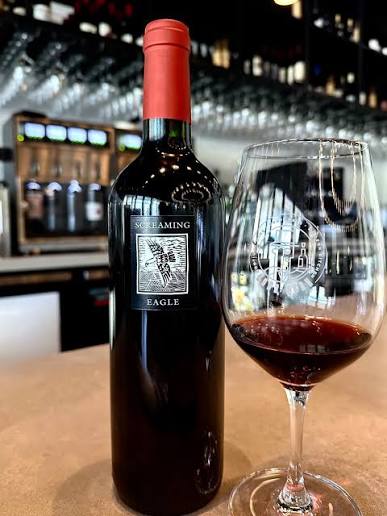
Serving Screaming Eagle Wine: Doing Justice to the Price
The most consistent mistake buyers make when they finally open a bottle of Screaming Eagle wine — regardless of vintage — is not giving it enough time to breathe. This is a wine of extraordinary density that requires patience at every stage of its life.
Decanting: A minimum of 4–6 hours for any Screaming Eagle wine within its first 15 years from vintage. Younger vintages — 2018, 2019, 2021 — benefit from even longer decanting. The transformation between the first pour directly from the bottle and the wine after six hours in a wide-based decanter is dramatic enough to convince even experienced tasters they are drinking a different wine.
Temperature: 16–18°C. Too cold and the extraordinary tannin structure tightens aggressively. Too warm and the alcohol becomes pronounced at the expense of the precision and freshness that makes Screaming Eagle wine distinctive within the Napa Cabernet category.
Glassware: A large-bowled Burgundy glass rather than a standard Bordeaux glass. The additional surface area allows the aromatic complexity to open more fully — particularly important in a wine where the secondary and tertiary notes are as extraordinary as the primary fruit.
Food: Dry-aged beef fillet, roasted rack of lamb with herbs, venison haunch with root vegetables. Preparations with the protein weight and savoury complexity to match the extraordinary structure of Screaming Eagle wine. Aged hard cheeses — Comté 36 months, Parmigiano-Reggiano — are outstanding companions for mature vintages where the tannin has fully integrated.
For gifting occasions where Screaming Eagle wine is the centrepiece, visit our gifts collection → and our Champagne gift delivery guide → for presentation and packaging options across the full Noir Cellars fine wine range.
How to Buy Screaming Eagle Wine Online: The Non-Negotiable Standards
Given the Screaming Eagle wine price — which begins at approximately $4,500 per bottle for the most accessible current vintages — every standard applied to buying online must be absolute.
Provenance documentation is non-negotiable. Purchase invoice from an authorised fine wine source, continuous temperature-controlled storage history, and original packaging integrity are the foundation of every legitimate Screaming Eagle wine purchase. Without this documentation, resale value is materially compromised and authenticity cannot be verified. At Noir Cellars, every Screaming Eagle wine we stock carries complete chain-of-custody documentation from source to our cellar.
Cold-chain integrity throughout. The extraordinary phenolic structure of Screaming Eagle wine is sensitive to temperature fluctuation in ways that less delicate wines can tolerate. Any heat exposure during storage or transit permanently compromises the wine that the Screaming Eagle wine price reflects. Every Noir Cellars order ships in thermally insulated specialist wine packaging with full insurance cover.
Buy from an authorised specialist retailer. Screaming Eagle wine sourced outside authorised channels carries provenance risk that no secondary market buyer will accept without discount. The Screaming Eagle wine price at this level demands supply chain certainty — and that certainty comes only from specialist retailers with established fine wine merchant relationships.
Buy Screaming Eagle wine at Noir Cellars → — multiple vintages, full provenance documentation, temperature-controlled storage, insured worldwide delivery. Contact concierge@noircellars.com for vintage-specific availability and pricing.
Frequently Asked Questions
What is the Screaming Eagle wine price in 2025?
Current Screaming Eagle wine secondary market prices range from approximately $4,500–$6,000 per bottle for the 2021 vintage through $6,500–$9,000 for the 2018, rising to $10,000–$18,000 for the 2010 and 2007 perfect-score vintages. The 1992 debut vintage trades at $15,000–$22,000. Primary mailing list prices are significantly lower — typically $900–$1,500 per bottle — but primary access requires joining a closed waiting list with no guaranteed timeline. Visit our Fine Wine Napa Valley collection → for current pricing.
Why is Screaming Eagle wine so expensive?
The Screaming Eagle wine price reflects three structural factors that cannot be changed: production of approximately 500–850 cases annually from 57 acres of Oakville vineyard, multiple perfect 100-point critical scores from Robert Parker, and a global collector demand that dramatically exceeds available supply. The arithmetic of these three factors — fixed supply, validated quality, growing demand — produces a secondary market price floor that has remained intact through every fine wine market correction since the estate’s founding.
How do I get on the Screaming Eagle wine mailing list?
The Screaming Eagle wine mailing list is currently closed to new applicants. The estate accepts expressions of interest through its website — screamingeagle.com — with no timeline commitment on when or whether new members will be added. The waiting period is measured in years. For most buyers, the secondary market is the only practical route to Screaming Eagle wine ownership.
Which Screaming Eagle wine vintage is the best?
The 2007 is widely considered the single greatest expression of Screaming Eagle wine in the modern era — earning 100 points from Robert Parker at its initial release review. The 2010 is the second 100-point vintage. The 1992 debut remains the most historically significant. For current drinking window quality at the most accessible secondary market price, the 2013 and 2016 vintages represent the strongest combination of critical acclaim and reasonable availability.
Is Screaming Eagle wine a good investment?
Screaming Eagle wine has demonstrated one of the most consistent and dramatic secondary market appreciation records of any wine produced in the New World. The 1992 vintage acquired at $75 on the mailing list now trades at $15,000–$22,000. The structural scarcity — 500–850 cases annually, no retail distribution — combined with perfect critical scores and growing global collector demand creates investment dynamics that are among the most compelling in all of fine wine. Read our investment grade wine guide → for full portfolio context.
How does Screaming Eagle wine compare to Opus One?
These wines serve fundamentally different purposes. Opus One wine produces approximately 25,000 cases annually and trades at $350–$480 per bottle — it is the most liquid and accessible Napa investment wine with a deep, established global secondary market. Screaming Eagle wine produces 500–850 cases annually and trades at $4,500–$18,000 — it is the most structurally scarce, highest-ceiling Napa investment wine. Read our complete Opus One wine guide → for the full comparison.
Where can I buy Screaming Eagle wine online?
Noir Cellars stocks Screaming Eagle wine across multiple vintages with full provenance documentation, temperature-controlled storage from receipt, and insured worldwide delivery. Visit noircellars.com/fine-wine/napa-valley → or contact our concierge team at concierge@noircellars.com for current vintage availability and pricing. For investment-grade case purchasing, OWC format is strongly recommended and can be requested at the time of order.
Screaming Eagle wine — the most elusive and most coveted Napa Cabernet ever produced — is available at Noir Cellars across multiple vintages with full provenance, temperature-controlled storage, and insured worldwide delivery. Visit noircellars.com/fine-wine/napa-valley or contact concierge@noircellars.com.